By Alfred Wimmer, Project Manager for industrial and commercial losses at BELFOR Austria, published in AssCompact Österreich, August 2026
Insurance coverage for industrial clients against flooding and heavy rainfall has become increasingly difficult to obtain in Austria. What options remain for brokers when insurers decline or restrict coverage? I suggest broadening the perspective: moving away from pure exposure and toward overall risk quality.
Coverage is the goal – insurability is the challenge
Insurers are becoming more selective. Climate risks are changing how flooding and heavy rainfall are assessed, and fire risk also remains a key concern.
At the same time, many sites have already implemented the most obvious preventive measures. Going further is often either no longer feasible or only possible at costs that are difficult to justify economically.
The exposure itself remains. A company cannot simply close its location and relocate production. And when it comes to the biggest cost driver in a loss scenario—business interruption—companies and insurers often have very different perspectives.
Just negotiate harder?
Is a more aggressive negotiation approach enough to secure coverage? Probably not. But a different line of argument is possible: not just how risky a site is, but how manageable a loss event would be.
Those who can credibly demonstrate, “We fully understand our flood and heavy rainfall risks—and we have control over our response,” shift the discussion toward risk quality.
The real pain point: business interruption
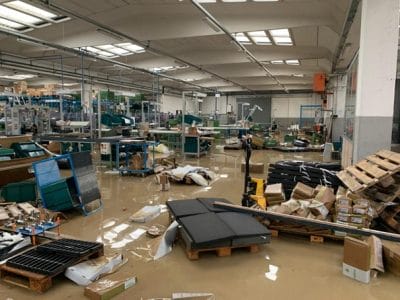
For industrial companies, property damage is often only part of the problem. Production downtime is usually far more critical. Looking at 50 years of our project history, and comparing restoration costs with daily business interruption losses, the difference is striking: business interruption losses are many times higher than pure property damage.
Physical assets can be replaced with money. But reputation, market confidence, and delivery capability cannot. Companies that have a robust plan to minimize business interruption after a loss improve their risk quality and strengthen their position in the market for coverage.
Getting business interruption under control
In simple terms, three factors determine whether a business interruption becomes a difficult episode. Or the final chapter in a company’s history:
- Acting quickly limits damage and consequential losses.
- Having the right expertise on site fast enables a quicker return to operations.
- Doing the right things correctly saves weeks.
It may come as a surprise, but these questions are often not clearly addressed in business continuity plans. That’s understandable: when the focus is heavily on prevention, response tends to receive less attention.
An update for the Business Continuity Plan
With RED ALERT®, our emergency response program, we provide the missing building block: a contractually defined, fast, and process-secure loss response. The agreement resolves organizational hurdles in advance, enabling immediate action when a loss occurs.
During peak periods following floods and heavy rainfall, RED ALERT® customers receive priority, ensuring that the global leader in restoration is on-site exactly when they are needed most.
In the end, the client will win
RED ALERT® gives brokers and companies a lever to visibly improve risk quality. Not through additional prevention requirements, but through a prepared and prioritized response to loss.
If this makes coverage possible, it is already a success. And if a loss does occur, there is a plan, priority access, and a real chance of reducing business interruption to a minimum.

Connect with Alfred Wimmer on LinkedIn