The Biggest Driver of Fire Loss Costs Is No Longer Just Rebuild
Waste, Contamination, and Downtime Are Playing an Increasingly Large and Growing Role.
– by Dariusz Kurowski, BELFOR Poland – published in Miesięcznik Ubezpieczenia (Insurance Monthly), January 2026
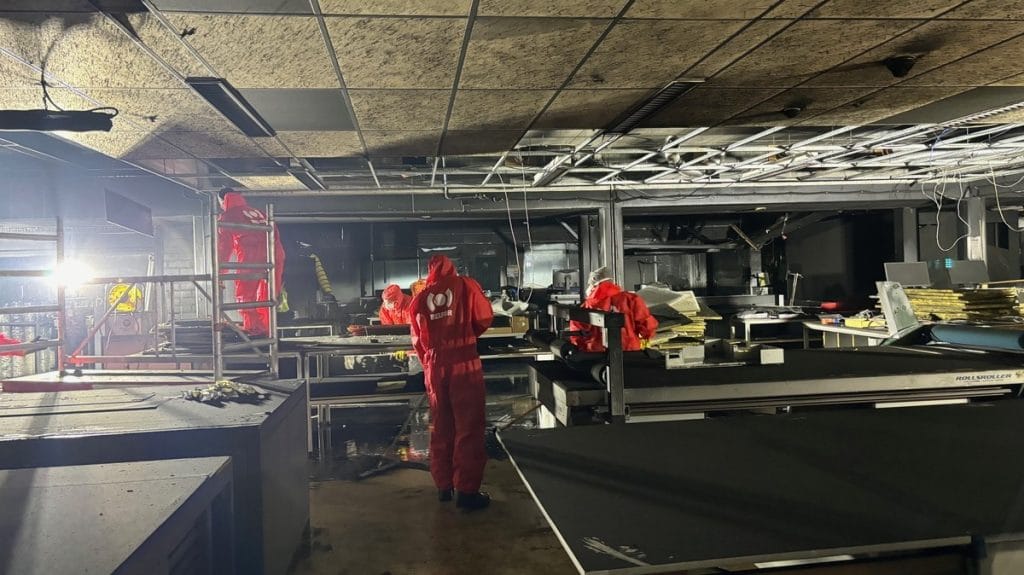
Fires in industrial facilities are among the most complex and costly property losses handled by the insurance market. Their consequences extend far beyond the direct destruction of buildings, machinery, or inventory. Increasingly, it is not the reconstruction of infrastructure itself, but rather the disposal of post-fire waste, decontamination, and prolonged production downtime that determine the final amount of the loss.
From insurers’ perspective, a clear shift in the cost structure of industrial losses is visible. Waste, only a secondary element a few years ago, today often becomes one of the main cost components. In addition, the market must contend with new hazards, such as lithium-ion battery fires, which generate waste with a high degree of chemical contamination and significant secondary risks. Brokers face the need to obtain a policy for the client that will be able to cover the costs associated with the disposal of hazardous waste.
THE FIRST 24-48 HOURS – THE KEY TO LIMITING LOSS COSTS
Fire damage in industry is not only the effect of flames. Products of combustion, acidic and corrosive deposits, soot, extinguishing powder, and the water used during firefighting can be just as destructive. In facilities with production lines, automation, and control systems, a lack of rapid response leads to so-called secondary damage, which often generates higher costs than the initial destruction.
Our experience clearly shows that the first 24-48 hours after a fire are absolutely crucial for the subsequent course of the claim settlement.
This is the moment when decisions must be made very quickly, often with limited information and an incomplete picture of the extent of damage. At that time, the technical knowledge and experience of the team have a real impact on whether the loss will be managed rationally or whether its cost will start to escalate dramatically.
In the first hours after the incident, properly identifying secondary hazards is essential, such as the presence of aggressive fire residues, moisture, chemical contamination, or the risk of accelerated corrosion. This is when we conduct chemical analyses, corrosion tests, and moisture measurements, and implement temporary anti-corrosion protection. These actions determine whether machinery and infrastructure can be restored or will be irreversibly sent for disposal.
Mistakes made at this stage are very costly because they are often irreversible. A delayed response, failure to secure property, or an incorrect technical assessment can lead to a sharp increase in waste volumes, loss of restoration potential, and a significant extension of production downtime. From an insurance perspective, this means higher reserves, a longer claims process, and lower predictability of the entire loss.
On the other hand, the right decisions made in the first 24-48 hours pay off very quickly. They make it possible to limit the scope of disposal, shorten plant downtime, and in many cases reduce the total loss cost by even several dozen percent. That is why it is so important that, already at this stage, the process involves an experienced engineer who has not only knowledge, but also practical experience and access to modern restoration technologies.
An additional difficulty is the limited capacity of the waste-processing market in Poland.
In industrial losses, waste volumes are often counted in hundreds or thousands of tons. These are complex mixtures of burned plastics, cables, electronics, steel structures, insulation materials, and finished products. After contact with combustion products, a significant portion of these materials must be classified as hazardous waste, which entails laboratory testing, special packaging, transport, and compliance with strict administrative requirements.
Most installations operate under annual limits which can be exhausted long before the end of the year. As a result, insurers and loss-adjustment entities are forced to look for facilities capable of accepting waste in increasingly distant locations. This leads to a longer claims settlement process and a significant increase in transport and administrative handling costs. In market practice, it can even happen that the same loss reported in January and in November differs in disposal costs, not because of its scale, but because “the waste limit has already been used up.” Toward the end of the calendar year, disposal costs can therefore rise faster than reserves, which can surprise even the most experienced participants in the process.
EXAMPLE OF A MEAT PROCESSING PLANT – WHEN DISPOSAL OUTWEIGHS RECONSTRUCTION
Fires in meat-processing plants and cold-storage warehouses are particularly problematic. After an incident, meat becomes mixed with elements of the building structure, melted crates, metal shelving, and contaminated firefighting water. The resulting waste is neither classic organic waste nor typical construction rubble. In many cases, everything must be classified as hazardous waste. This means the need for segregation, laboratory testing, preparation for transport in accordance with stringent regulations, and finding a facility capable of accepting such a fraction. In practice, organizing disposal can take longer than restoring machinery and infrastructure, and its costs can significantly exceed the initial loss estimates.
LITHIUM-ION BATTERY FIRES – A NEW SYSTEMIC RISK
An increasingly major challenge for the insurance market is lithium-ion battery fires, commonly used in vehicles, energy storage systems, and many devices. Such events differ significantly from classic fires. They are characterized by very high combustion temperatures, a prolonged course, and difficulty in extinguishing. They are accompanied by emissions of toxic and highly corrosive gases, which cause extensive chemical contamination extending beyond the immediate fire zone.
From a loss-adjustment perspective, this means not only serious thermal damage, but also a high risk of extensive secondary damage to infrastructure, machinery, and technical installations. Fire residues resulting from lithium-ion battery combustion are strongly corrosive and toxic and can lead to permanent degradation of metal components, electronics, and control systems. Their presence very often necessitates costly decontamination processes and, in extreme cases, complete replacement of equipment that was not formally exposed to direct flame impact.
The consequence of such events is also waste with a high degree of chemical contamination, including both remnants of burned components and elements of infrastructure secondarily contaminated by fire residues. Even surfaces and installations that show no visible signs of damage often require specialist decontamination before they can be approved again for safe use. For insurers, this translates into a significant increase in loss costs, a longer adjustment process, and greater uncertainty regarding the final scope and value of the damage.
THE ROLE OF THE RESTORATION ENGINEER IN THE CLAIMS PROCESS
In this context, the role of the engineer responsible for the technical management of the loss becomes crucial. Already during the initial inspection, this person assesses the real extent of damage, identifies secondary risks, and indicates which assets can be restored. Engineering knowledge, experience gained from similar losses, and access to specialist technologies become the decisive factor in how the settlement proceeds.
The experience of entities such as BELFOR shows that involving an experienced engineer within the first hours after an incident can significantly reduce the volume of waste and enable rational planning of decontamination. The engineer acts as a link between the worlds of technology, insurance, and waste logistics, providing insurers and brokers with reliable foundations for decision-making.
RESTORATION AND DECONTAMINATION AS A TOOL FOR COST CONTROL
Post-fire decontamination remains one of the most underestimated stages of loss settlement. It includes chemical neutralization of deposits, cleaning of machinery, HVAC installations, control cabinets, and structural elements of the building. Combined with restoration, it makes it possible to reduce the volume of waste, shorten downtime, and reduce the total loss cost by as much as 30-60%.
From an insurer’s perspective, this means a more predictable settlement process and a real reduction in technical reserves. Brokers, in turn, gain an advisory tool that allows them to actively support clients in minimizing losses, rather than merely reacting to their consequences.
CONCLUSIONS FOR THE INSURANCE MARKET
Rising disposal costs, limitations of the waste-processing market, and the emergence of new technological risks mean that the classic settlement approach – based solely on replacing property – is becoming increasingly less effective economically and organizationally. In the reality of modern industrial losses, it often results in uncontrolled cost growth, a longer settlement process, and increased uncertainty regarding the final scope of damage.
In this context, restoration and decontamination, carried out under the supervision of an experienced engineer with the appropriate technical knowledge and practical expertise in managing fire losses, cease to be an alternative solution. They become an important tool for managing the cost of industrial fire losses, enabling a reduction in waste volumes, shorter production downtimes, and greater predictability of the settlement process. Our experience shows that properly planned restoration actions increasingly determine the economic outcome of the entire loss, both from the insurer’s perspective and that of the affected company.
The Author

Dariusz Kurowski
BELFOR Poland
Connect on LinkedIn