Two Years On: Were the July 2021 Floods in the Ahr Valley Only a Preview?
by Martin Schachtschneider, BELFOR Germany, first published in VersicherungsPraxis (GVNW), July 2023
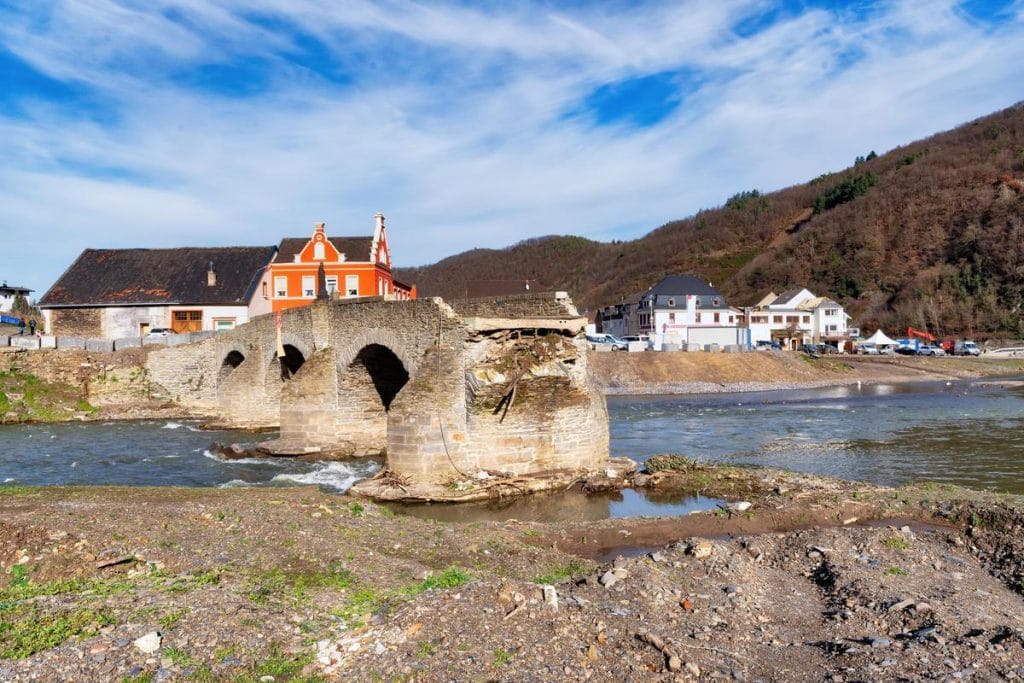
This article looks back at the July 2021 floods in the Ahr Valley, an event often described as a once-in-a-century flood that hit Germany and parts of Central Europe. In Belgium and Germany combined, the disaster claimed more than 230 lives and was classified by the German Insurance Association (GDV) as “the most devastating natural catastrophe in Germany for property and motor insurance”.
What lessons can be drawn from this? What new challenges does it create for the economy, insurers and service providers?
I describe these topics from the perspective of a loss and restoration service provider. Looking back on 20 years in the profession, I have now experienced three so-called once-in-a-century floods and coordinated and supported the resulting restoration work.
Starting with the “flood of the century” on the Elbe and Danube in August 2002, then the floods of summer 2016, and finally the losses from the July 2021 floods in the Ahr Valley.
The July 2021 floods in the Ahr Valley as an extreme weather event
On 13 and 14 July 2021, a weather pattern destroyed entire villages in the Ahr Valley within 24 hours. A low-pressure system caused persistent, recurring heavy rainfall across a wide area. From 13 to 15 July 2021, this system remained largely stationary over Central Europe and for days drew warm, moist Mediterranean air along its southern and eastern flank.
The result was widespread, extremely heavy rainfall in western Germany and eastern France, with peak totals of up to 150 litres per square metre within 24 hours in parts of Rhineland-Palatinate and North Rhine-Westphalia.
This was compounded by the fact that Germany had already experienced substantial rainfall in the preceding weeks. Soils were saturated and could absorb very little additional water. Another factor was the specific terrain profile in the affected region.
Public attention focused above all on the Ahr Valley. In reality, however, as the rain continued, other mid-sized and larger rivers also overflowed their banks, including the Emscher, Erft, Kyll, Lippe, Prüm, Ruhr, Sieg, Wupper and the Rur in Belgium.
The challenges and risks are well known
The July 2021 floods in the Ahr Valley demonstrated how devastating extreme weather can be, and how important it is to respond to the risks of climate change. The World Economic Forum’s Global Risks Report 2023 accordingly places climate change and related natural catastrophes in the top three risks in its 10-year outlook:
- Failure to mitigate climate change
- Failure to adapt the economy and infrastructure to climate change
- Natural disasters and extreme weather events themselves
Our task now is to learn from these events and prepare companies as effectively as possible for what lies ahead. It is clear that disasters like those of 2021 are no longer “black swan” events.
After the July 2021 floods in the Ahr Valley, Covid-19, and the supply-chain disruptions following the Beirut explosion or the Ever Given in the Suez Canal, in my view no one can credibly claim anymore to have been hit unexpectedly. Today, no one should be surprised by a major fire or a natural catastrophe. In my view, identifying risks, mitigating them and transferring risk will no longer be sufficient going forward.
Financial losses from the July 2021 floods in the Ahr Valley
To put the event into perspective, it helps to look first at the loss figures. In March 2022, Germany’s Federal Ministry of Finance (BMF) published the following numbers: property damage of more than EUR 33 billion, plus a further roughly EUR 7 billion in interruption losses in industry, trade and commerce. Overall, the financial losses from this natural catastrophe are estimated at EUR 40.5 billion.
The GDV, by contrast, reports insured property losses of EUR 8.5 billion, covering claims with loss dates between 13 July 2021 and 18 July 2021.
That means we are looking at just six days, and at the same time a gap between insured losses and uncovered costs of EUR 24.5 billion for property damage alone, excluding business interruption or contingent business interruption losses.
For comparison, the German Insurance Association reports annual payouts by its member companies that have remained stable for years at around EUR 14 to 15 billion per year for property claims.
In other words: EUR 8.5 billion in six days versus EUR 14 billion spread across 365 days. This meant that, in July 2021, employees and structures at insurers, brokers and service providers were expected to absorb and process an additional 60% of a typical annual volume within a single week.
Based on these figures, the average weekly property-claims payout is EUR 269 million. In week 28 of 2021, it was EUR 8.5 billion, equivalent to 3,157% of a “normal” week.
Too much work and even fewer resources
These numbers highlight the core challenge in dealing with the consequences of the July 2021 floods in the Ahr Valley: resource availability at a time already shaped by shortages of skilled labour and supply-chain problems.
In addition, there was no advance warning and no grace period for companies and responders, unlike earlier floods on the Elbe and Danube, where gauge levels rose over days and flooding was specifically forecast.
Those earlier floods lasted for days, and it took days for the water to recede. In 2002 and 2013, insurers, brokers, surveyors and service providers had time to prepare and organise into teams, establish infrastructure and set up communication centres.
Adjusters and surveyors working at full stretch
In the summer of 2021, the disaster caught many affected parties completely off guard. The first bottleneck for companies was simply being able to assess the situation at all and discuss it with their insurers. Claims departments suddenly had to process thousands of additional loss reports at the same time. In the industrial sector, however, there are only limited numbers of loss adjusters and surveyors available.
Prioritisation was hardly possible due to the lack of shared, digital and standardised tools in industrial insurance. Who was able to report their loss first? Who had a broker, a surveyor or an adjuster on site within the first days to assess the situation and advise?
And if that did not happen, how were decisions supposed to be made? We saw large corporations affected whose headquarters were outside Germany, and who needed days simply to place their own loss.
If you could not get expert help immediately, you had to wait
Those who could not act quickly could no longer access tradespeople, materials or even basic drying equipment. In that situation, this meant that even if you were well insured, there was simply no help available, not for money, and not for good words. Or it came only later than it did for your peers and competitors.
Anyone like us who was travelling through Rhineland-Palatinate and North Rhine-Westphalia in the first days and weeks after the disaster quickly realised that it would be difficult for the next 24 months to get a tradesperson, an electrician, a new heating system or simply screed.
Across kilometres and countless towns one of the first desperate measures could be seen in the mountains of waste along the roads: damaged furniture and heating systems, and building installations removed from flooded properties.
For us, this was a clear sign that at least basements and ground floors had been under water. And we are not talking about buildings flooded by clean water from a drinking-water pipe.
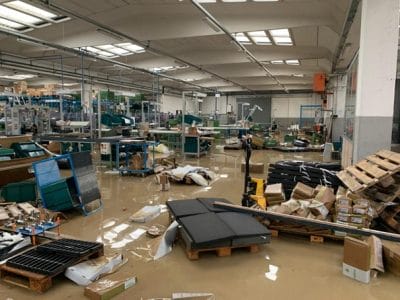
In reality, every flood picks up a wide range of contaminants and deposits them in buildings, businesses and production facilities. Contamination such as sludge, dead animals, oil from ruptured tanks, chemicals, or components from sewage systems means that buildings often have to be extensively stripped out.
As a rule, they must be taken back to a bare-shell condition to at least half a metre above the waterline: breaking out screed and installations, removing plaster, and stripping wall and floor finishes. Furnishings are typically a total loss anyway.
High demand for restoration specialists
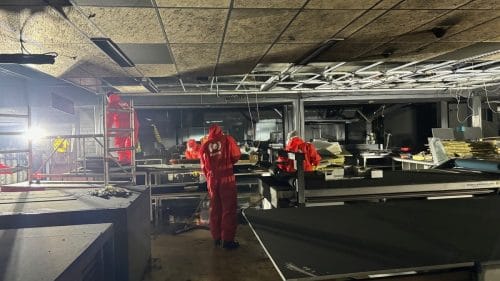
The same naturally applies to losses in trade and industry. Machines and electrical control cabinets have to be dismantled in the smallest detail and cleaned. Sediments have penetrated every crevice and consist of contamination from the pollutant load—across every surface of the equipment. Corrosion caused by moisture and critical contamination pose an immediate threat to assets.
In concrete terms, this means the loss does not stop developing when the water recedes. In fact, that is precisely when the clock starts ticking and the course is set: either “repairable within days or weeks” or “developing into a total loss”, with replacements and delivery lead times of months.
Anyone who loses just a few days in the initial response and first mitigation measures often pays for it with months of additional business interruption. The next bottleneck is therefore specialised companies for loss remediation.
Destroyed infrastructure, no power
In July 2021, another reality became clear very quickly: the unprecedented scale of destroyed infrastructure. Many loss locations could initially not be reached at all, or only via major detours. Destroyed bridges and roads blocked access routes. Along the Ahr, for initial inspections we could reach sites only on foot for days.
And when first measures were to begin, the most important piece of equipment was the emergency generator. Without power there is no lighting, no effective tools and certainly no technical drying. As restoration specialists, we had previously dealt with scenarios where we had to supply customers and sites with generators for a few hours or a few days. On some of our projects from July 2021, we had to ensure power supply via mobile generators until October 2021.
Especially in the Ahr Valley, there were scenes we otherwise know only from reports from war zones. Our employees experienced the suffering and desperation of those affected at close range. As a company, we had set up an internal hotline for psychological stress at the workplace many years ago, but it had remained unused for years. Suddenly, it was used very regularly. Even hardened restoration professionals, accustomed to seeing destroyed sites and buildings, had to process what they had experienced, talk about it and seek professional help.
This natural catastrophe amplified the importance of many issues. With scarce, valuable resources, it is essential to deploy them carefully. And that requires proper prioritisation. At the top of the list is access to shared information. Without standardised digital interfaces between the stakeholders in industrial insurance, however, this is difficult to achieve.
Skilled labour shortages, broken supply chains, inflation and a hard market
This is followed by the issue of skilled labour shortages. Skilled workers are known to be scarce across all functions and hierarchy levels. We know that over the next 10 years, roughly twice as many workers will retire each year as young people enter the workforce. What happens if all companies in a region suddenly need additional support at the same time?
Supply-chain problems, the resulting chip shortages, and delivery issues for electrical equipment, or even entire machines, were already a challenge in 2021 and have not eased since. The terrible war in Ukraine is currently on everyone’s mind. Tensions between China and Taiwan suggest this situation may not ease. Inflation is pushing prices up.
The hard market in industrial insurance has likely led some to choose higher deductibles or shorter indemnity periods. All in all, this is not a comfortable starting position for future natural catastrophes.
Natural disasters are increasing globally, and so are the losses
Personally, I have experienced several once-in-a-century events in Germany over the course of my career. Globally, events such as Hurricane Katrina (2005) and the series of tropical storms in 2017 (HIM, Harvey, Irma and Maria) have particularly stayed with me.
However, the latter were only three of ten severe storms in the Atlantic hurricane season of 2017. And looking at the Pacific region, we have recently seen customers heavily affected by typhoons in 2021 and 2022.
Annual growth trend
Climate change will certainly also lead to major events in Europe in the near future.
The Sigma study published annually by the Swiss Re Institute expects a further increase in natural catastrophes, both in frequency and in severity.
This raises the question of what recommendations can be derived for companies and their risk and insurance managers.
Recommendations for companies and their risk and insurance managers
Most companies will already have business continuity management plans, and there will certainly be a defined internal crisis team. However, in numerous preparatory discussions with industrial clients, we found that these plans often remain within internal structures. In a catastrophe, however, you will very quickly need to request and coordinate targeted external support.
Trying to find, select and brief external partners only once a crisis hits will not work. Seemingly basic formal processes, such as registering a supplier in procurement, obtaining approval, and raising a purchase order, will fail in a crisis without preparation. A confidentiality agreement cannot simply be produced and signed on the spot, especially not if the emergency occurs on a weekend, a public holiday, or on another continent.
1. Secure resources in advance
My clear recommendation is to think about a service provider far in advance and secure their resources, ideally for all global sites. Ideally in dialogue with insurers and brokers. Service providers, too, will have to prioritise their resources in situations like 2021, even when, as in our case, board members took on project leadership, colleagues from across Europe supported, and employees cut their holidays short.
2. Align the loss process while the lights are still on
My second recommendation is to agree a potential loss process in advance, calmly, between the various parties involved while the lights are still on. After a fire, you are literally groping in the dark of a soot-covered hall; and during floods, power will also be out and no lights will be on. In such a situation, the need for discussion between stakeholders should be kept as low as possible. Many (commercial) topics and responsibilities should be clarified well in advance.
The advantage is that a process aligned with the carrier enables immediate loss-mitigation measures. There is no need to wait for an insurer’s go-ahead. The insurer’s claims organisation is relieved and the overall loss is reduced.
3. Clear points of contact and reporting chains with service providers
All good things come in threes. Points of contact and key players should be defined just as clearly. In addition to the contact details of an internal crisis team, it is advisable to integrate defined contacts at insurers, brokers and service providers into emergency plans and to define an alerting process. No time should be lost in escalation and reporting paths.
Service providers also need a clear point of contact who can name the company’s real priorities. Not every machine can be restored immediately. In that case, the focus should be on the production area with the highest value creation or the largest interruption exposure. A service provider can only do this properly in dialogue with a strong, empowered counterpart. Ideally, you have already met personally as partners in advance. The service provider knows the company’s key sites, is prepared for hazardous substances and is known to the local team.
Preparation through contracts and processes
Ultimately, preparation for future natural catastrophes or major losses will be a decisive competitive factor. In a crisis, response time is extremely limited.
The July 2021 floods in the Ahr Valley changed public opinion on climate change like few other events. The floods of 2002 and 2021 likely even had a significant influence on federal elections.
Decision-makers were measured more than ever by their crisis capability, leadership strength and preparedness. Here too the advice is to be demonstrably prepared – documented, contractually and in process descriptions.
What preparation should include:
- 24/7 emergency response availability
- Coverage of all company locations
- Priority
- Binding processes
- Binding response times
- Confidentiality
If the July 2021 floods in the Ahr Valley were only a preview, we have every reason to prepare together for similar events. Let’s tackle it together!
Ideally, you have already met personally as partners in advance. The service provider knows the company’s key sites, is prepared for hazardous substances and is known to the local team.