Italy Earthquake Loss: BELFOR Stabilizes Structures and Recovers Industrial Assets in Damaged Parmesan Facility
Case study from the archive · First published in 2011
After a 5.9 earthquake in Emilia-Romagna, Italy, BELFOR Italy rapidly mobilized engineers and disaster recovery teams to stabilize damaged structures and assess industrial losses, including a severely impacted Parmesan cheese producer. Despite collapsed high-bay storage systems and ongoing seismic risk, BELFOR implemented a safety-first recovery strategy, combining structural stabilization with partially remote-controlled salvage operations. Within four weeks, around 700 pallets of goods were recovered, enabling the client to resume partial operations and significantly reduce total loss.
Modena, 20 May, 4:03 a.m.: An earthquake of magnitude 5.9 on the Richter scale shakes the Italian province of Emilia Romagna. Its epicentre is the small town of Finale Emilia in the province of Modena. Depth 6.3 km. 6 fatalities, thousands of evacuees, enormous damage to architectural monuments and homes and major problems for countless companies.
Filippo Emanuelli, Managing Director of BELFOR Italia, explains what happened in the hours after the earthquake:
Rapid Response: Emergency Assessment and Task Force Deployment
In the early hours of Sunday, 20th May, a company task force was mustered with the purpose of defining what needed to happen next: it ascertained the nature and extent of the event, and defined an effective and specific solution for handling the emergency situation. Using the customer geolocalisation system PIA (Pronto Intervento Azienda), we were able to establish initial contact by telephone in order to find out what level of damage our corporate customers had sustained, and to provide initial advice over the telephone.
Based on the situation and our experience, we sought out the right specialists for the task force: the team included construction engineers to assess the static stability of the buildings, engineers to secure the buildings with temporary constructions (e.g. multi-directional supports and props) aimed at supporting the damaged structures (such as struts or beams), demolition / reconstruction engineers, etc.
From the morning of Monday, 21st May 2012 onwards, we were on site and began the first of forty checks that were carried out in total during the days after the earthquake. Among the companies that we carried out checks on today is a manufacturer of Parmesan cheese.
Complex Loss Scenario: Structural Damage and Perishable Goods at Risk: The Albalat Case
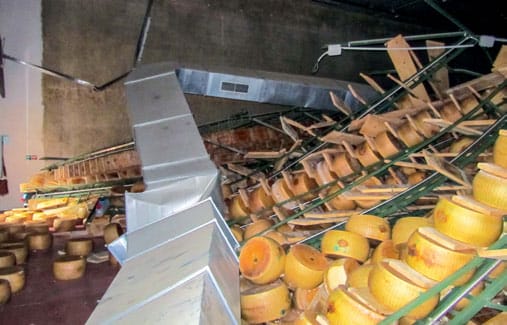
Albalat is a member of the GRANTERRE consortium and produces Parmesan cheese. The factory in Modena comprises a cheese production hall with a capacity of over 150 wheels per day and 5 maturing halls. Following the earthquake, the high-bay storage units in the 4th and 5th halls have become structurally weakened and collapsed.
We were contacted at 1 p.m. on 21st May and we were on site at the cheese production hall by 3.30 p.m. The situation is hard to assess, since there are huge piles of cheese wheels and twisted units in front of the entrances to each of the 4 storage rooms we inspect.
Each hall contains 12 high-bay storage units, each containing 20 maturing shelves, with each shelf holding around 95 wheels. That equates to around 90,000 wheels – a quantity of food that cannot be wasted.
In the storage room with the least damage, the high-bay units have not collapsed but do need to be structurally reinforced so that the risk of further collapse can be limited. Even the supply technology systems in the building have been damaged in some places; a number of components have fallen onto the wheels. Fortunately, the air-conditioning system is still working, which means that the temperature and humidity conditions required for the ripening process are maintained.
Many of the wheels are intact, while others exhibit mechanical breaks due to the impacts they sustained during the collapse of the shelving units. The wheels have to be rescued so that they, or at least some of them, can be used again. Further damage also has to be avoided wherever possible, which is why the wheels have to be rescued by hand while at the same time taking account of the employees’ safety.
The operational safety plan is then drawn up, explaining the planned operational phases. The plan sets out the following operational phases, listed in accordance with their priority:
1. Clearing of the access routes to the most badlydamaged storage units, with the dangerous unstable elements (air-conditioning system panels) and the cheese wheels lying on the floor having to be removed by hand.
2. Removal of the wheels from the high-bay storage units and positioning on pallets, so that they can be extracted from the halls as quickly as possible.
3. Stabilisation of the high-bay storage unit that was still standing in the warehouse with the least damage.
4. Removal of the pallets bearing the wheels from the working area.
5. Checking and storage of the wheels by the customer’s technicians.
The operational plan is approved by the cheese factory’s emergency team and their engineers, along with engineers from the insurance company. Work gets underway on Wednesday, 23rd May.
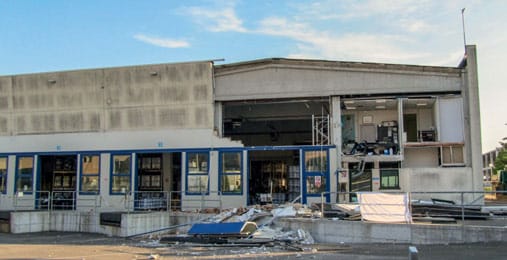
Operational Disruption: Secondary Earthquake and Increased Risk Exposure
Tuesday, 29th May, 9:00 a.m.: A further earthquake of magnitude 5.8 shakes the Emilia Romagna region yet again. This time, the epicentre is further to the north west, in Medolla. The earthquake causes massive damage to the structures that had already been weakened by the previous earthquake. 15 people are killed, many people are injured and many more are made homeless. Over 40 engineers from BELFOR are working in areas affected by the first earthquake, but all are safe apart from being very shocked by developments.
We have to interrupt our work and check the safety conditions. The difficulty in accessing the area requires particular improvisation skills. At one point, our employees even perform a cardiac massage during the long wait for the arrival of the emergency doctor. We also have to interrupt our regular work and check the safety conditions.
After 24 hours, we can carry on; the structures of the cheese factory have withstood the latest earthquake without problems, which means we are able to assess the resumption of the rescue work together with the safety coordinators. The work takes a total of 4 weeks, and on Friday, 22nd June, the completion log is signed. We’ve done it. However, the situation in Emilia is very complex; it will take a while before everything returns to normal, but from the 22nd of June, at least one company can look confidently to the future.
Innovative Approach: Remote-Controlled Salvage to Reduce Risk
Following the second powerful earthquake on the 29th of May, we were forced to revise our operational methods in light of the risky situation that had arisen as a result of the weakening of the structures already damaged by the first quake. Following appropriate stability checks on the structures and the deployment of suitable stabilising measures, we planned the individual next steps focusing squarely on the absolute safety of our employees.
Inside the structures, some of which were either damaged or had collapsed completely, there were products, items and equipment that needed to be rescued. Solutions were needed that would allow the rescue to be carried out and still allow these articles to be reused without direct employee involvement. The ongoing quakes made it clear to everyone that the complete safety of employees takes top priority.
Further efforts were needed, this time with a more creative approach, to come up with alternative solutions that would allow the reusable items to be transported out of the storage units without direct human involvement. Over the course of a few days, we therefore installed a video surveillance system that allowed the operational equipment to be monitored remotely. The operators were able to actuate the operational equipment from a safe distance without taking even the slightest risk in terms of their own safety.
Using diggers and forklifts, the pallets bearing the products were removed and loaded onto carts, then taken to a dedicated area outside where they were inspected by the customer’s employees. With this process, we were able to rescue around 700 pallets of material at a single company in a space of four weeks. Finished products, raw materials and semifinished products: after a close inspection by the customer’s employees, the company was able to at least partially satisfy its delivery conditions with the intact materials.