Laboratory Water Damage Restoration: Rapid Response Protects Millions in Research Assets and Scientific Equipment
Case study from the archive · First published in 2011
A major sprinkler system failure flooded a nutrition company’s R&D facility, causing severe water damage, structural collapse, environmental contamination risks, and potential loss of valuable research data. BELFOR’s emergency response teams stabilized the structure, recovered critical scientific documents and laboratory equipment, controlled mould and hazardous materials, and restored salvageable assets through specialized disaster recovery services. The rapid intervention significantly reduced secondary damage and helped the client resume research operations as quickly as possible.
At 2:30 in the morning, what could possibly go wrong? The Research and Development place. The building is empty, except for tens of millions of dollars of high-tech equipment, a facility is closed for the night. All of the appropriate safety and security precautions are in large inventory of chemicals, hours of on-going experiments, and invaluable research data and documents.
A leading provider of nutrition products could never have predicted what was about to happen to their multi-million dollar, 55,000-square-foot R&D facility.
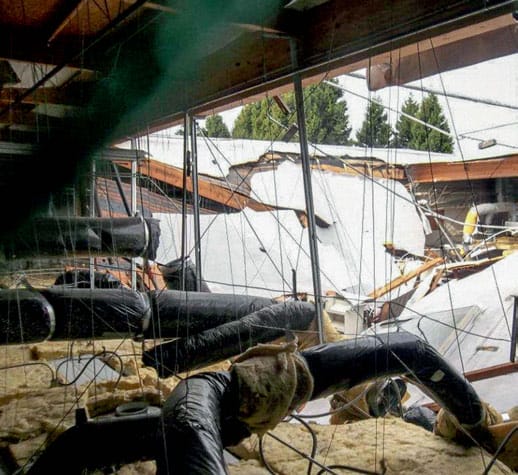
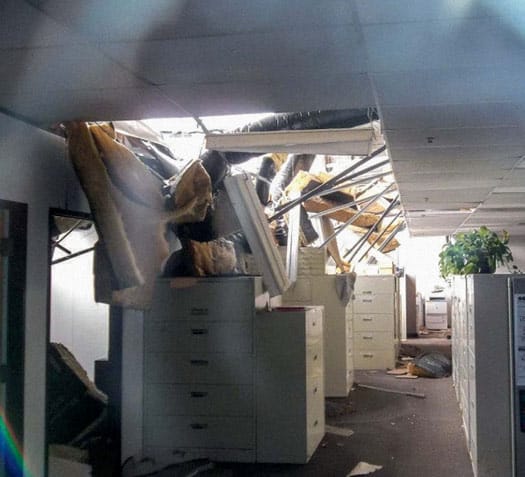
Without warning, the main sprinkler system pipe in the parking lot broke, sending a huge 30-foot flume of water skyrocketing into the air – and directly onto the roof of the facility. Before the water could be shut off, the roof drains were completely overwhelmed and the roof’s main beam collapsed under the pressure. Water poured into the building, literally covering every square inch of the facility. “If the water had gushed just 15 degrees in a different direction, this would never have happened,” said BELFOR Project Manager Steve Starr.
RED ALERT® relationship pays off
Thanks to an established RED ALERT® relationship with BELFOR, a committed management team, a very cooperative insurance carrier and some very quick thinking, all was not lost.
BELFOR got the call in the middle of the night, and the next day city inspectors deemed the building unsafe to enter. To prevent further damage to the contents inside, quick action was necessary. Because of BELFOR’s relationship with the RED ALERT® client, and knowing that time was critical, BELFOR immediately initiated an emergency response plan. BELFOR worked with a local engineer and the local building department to shore up and stabilise the structure.
Resources and equipment were mobilised on-site within hours, including temporary power generation and staging areas in the parking lot. The client (who wishes to remain anonymous) had two priorities – salvage as much of the research data and equipment as possible.
Extreme humidity, shut-off ventilation, and a potentially hazardous environment created huge challenges for the BELFOR team. First and foremost, safety was the most critical factor. In what was once a very sterile lab environment, BELFOR now found a potentially lethal concoction of fumes mixing and filtering throughout the air inside the building. Specialists from BELFOR Environmental were called to the site, and worked one-on-one with R&D scientists to identify, properly contain and dispose of all hazardous waste. “The quick response of our Environmental division reassured us that workers were not being put into a potentially hazardous situation. We were able to address the environmental issues promptly with our client and move forward with the recovery and restoration efforts,” Starr explained.
With the environmental issues under control, attention quickly shifted to the contents inside the building. A significant amount of documents and research data detailing valuable chemical equations and formulas were retrieved. The damaged documents were inventoried and placed in a thermal vacuum freeze-dry chamber at the local BELFOR office. Over one million cubic feet of air was aggressively dehumidified using desiccant dehumidification equipment. This helped stabilise the environment and prevented further corrosion to high-tech lab equipment.
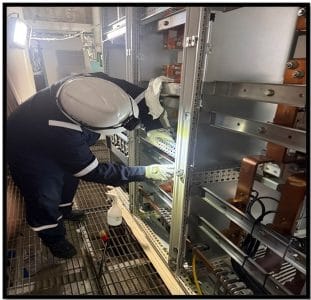
BELFOR teams in full PPE removed thousands of pieces of equipment from the building.
Tents were erected in the parking lot so that equipment could quickly be identified, evaluated, inventoried and decontaminated. Because of extreme conditions inside the building, hygienists on-site identified the formation of small mould spores. Crews ranging in size from 40-60 employees worked day and night in 12-hour shifts to dismantle or partially dismantle equipment, perform the necessary decontamination and mould remediation steps, and restore all salvageable pieces.
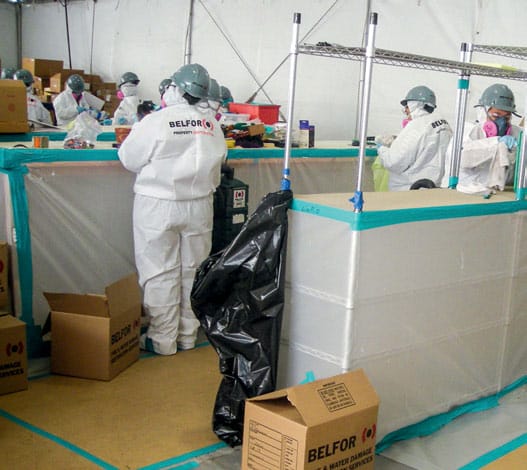
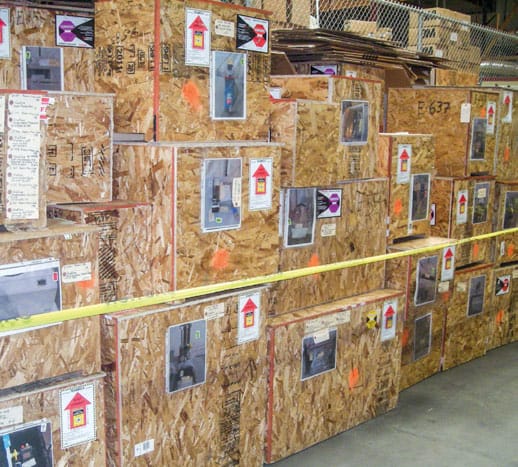
Custom crates for each piece of equipment were built onsite as well. BELFOR packed and transported the equipment to a temporary storage facility for safety. BELFOR also secured temporary climate controlled storage for chemical products removed from the building. Non-salvageable items were inventoried, removed from the building, sorted by waste stream and disposed of properly. The entire process took BELFOR less than 90 days to complete. “We were able to salvage equipment from the property that could have suffered significant damage had we not responded quickly. That quick response reduced the amount of secondary corrosion damage,” said Starr.
Back in business
“Our client has a new R&D facility so we are now delivering the equipment, documents and other salvaged contents to them. With teamwork, cooperation and determination, we were able to achieve our goal of getting this R&D facility back in business as quickly as possible.”